
If your marriage, your spouse or your property is tied to Brazil, you need a lawyer who practices Brazilian law, and the first thing that lawyer will tell you is that Brazil has no stand-alone “postnup” in the American sense. Spouses who want different property rules after the wedding ask a court to authorize a change of their marital property regime, and the new regime is then recorded so third parties are protected. A US-style postnup signed at a kitchen table does not do that work for Brazilian assets. We are Brazilian lawyers and practice Brazilian law only, so this guide covers what happens in Brazil and leaves US law to a US attorney.
TL;DR
- In Brazil, the post-wedding equivalent of a postnup is a court-approved change of the marital property regime, requested jointly by both spouses with a stated reason.
- If the spouses never chose a regime, partial community of property applies by default under Civil Code Article 1,640.
- A pre-wedding agreement (pacto antenupcial) must be a public deed, and without that form it is null.
- Cross-border marriages often need coordination among counsel, the court and the civil registry, not just a signed document.
- A Brazilian lawyer can handle all of this online, in English, without you traveling.
Table of Contents
- Why a US postnup does not settle your Brazilian assets
- The three regimes behind every marriage
- What the pre-wedding pact requires
- Changing the regime after the wedding
- When the marriage was celebrated abroad
- When an agreement becomes a dispute
- Is Brazil about to change these rules?
- What a Brazilian postnuptial agreement lawyer should be able to do
- Our perspective
- Talk to a Brazilian lawyer about your marriage and your assets
- FAQ
- Sources
Why a US postnup does not settle your Brazilian assets
In the United States, a postnuptial agreement is a contract between spouses signed during the marriage. Its rules differ by state, and a US family lawyer is the right person for them. That is not our practice, and nothing here is advice on US law.
Brazil works differently. Property between spouses is organized by a “regime de bens” (marital property regime), chosen before the wedding or fixed by default. Changing it later is not a private contract matter alone. The Civil Code allows a change during the marriage, but only with court authorization on a joint, reasoned request, and the court must preserve the rights of third parties. You can read the rule in Article 1,639 of the Brazilian Civil Code.
This matters for several kinds of readers:
- A foreigner who married a Brazilian and owns or plans to buy an apartment or land in Brazil.
- A Brazilian living abroad whose marriage was celebrated overseas but whose assets sit in Brazil.
- A couple that wants to separate business risk from family assets before one spouse opens a company.
- Heirs and spouses who will later face a Brazilian estate, where the regime decides who owns what.
The three regimes behind every marriage
Before asking what to change, you need to know what you start with. The Civil Code gives spouses a choice of regimes. The default is partial community of property. The Superior Court of Justice (STJ, Brazil’s high court for federal law) explains in its November 2024 overview of antenuptial pacts that when spouses do not stipulate another regime, Article 1,640 applies partial community.
In plain terms:
- Partial community: assets acquired during the marriage are generally shared, while certain assets, such as those owned before the marriage, stay individual.
- Another regime by agreement: spouses who want something different, such as complete separation, need a valid pre-wedding pact.
- Invalid pact, default regime: the STJ’s account says that if the required pact is not valid, the chosen regime is null and partial community applies.
The regime governs what each spouse can sell, what a creditor can reach, and who inherits. If you hold Brazilian real estate, the regime is not paperwork. It shapes every later decision. Our guide to prenuptial agreements in Brazil and changing the regime walks through the options in more detail.
What the pre-wedding pact requires
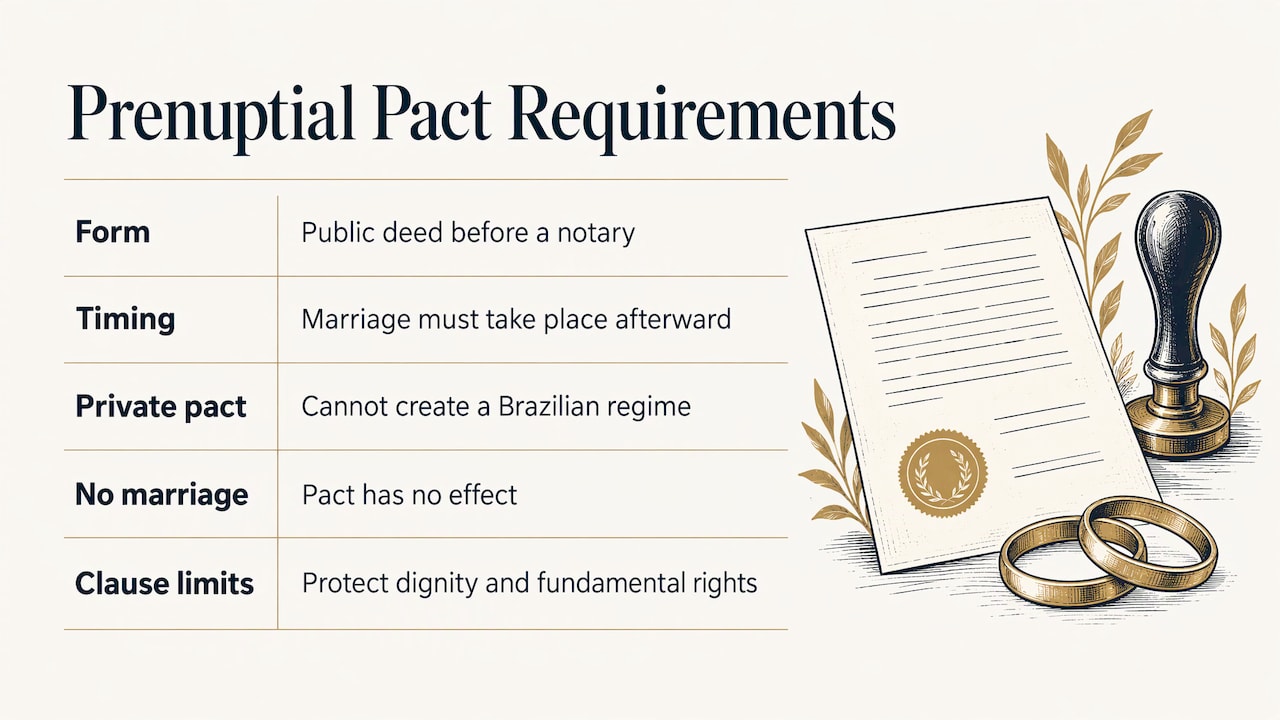
The closest thing to a Brazilian prenup is the pacto antenupcial. The STJ states that it must be executed as a public deed, which is a document formalized before a notary. It also says the marriage must actually take place afterward. Without the required form the pact is null, and without a marriage it has no effect.
Two practical points follow.
Form is part of validity. A private document that two spouses sign and keep in a drawer cannot create a Brazilian regime. If you married abroad and believe you have a “prenup”, a Brazilian lawyer should review whether it can have any effect on Brazilian property and how the marriage was recorded in Brazil.
Content has limits. The STJ notes that these pacts may include non-property clauses or indemnity clauses, but only within limits that protect dignity and fundamental rights and guarantees. A clause that tries to strip a spouse of basic protections is the kind that invites a dispute later.
For mixed marriages, where the two spouses come from different countries, the question of which country’s law governs adds another layer. See our article on prenups and property regimes for mixed marriages and the explainer on which country’s law applies to binational couples.
Changing the regime after the wedding
This is what people usually mean when they search for a postnuptial agreement lawyer in a Brazilian context. The route is judicial: both spouses file a joint, reasoned request, a judge evaluates it, and the court protects third parties. The Civil Code text on this is Article 1,639, paragraph 2.
The practical steps usually look like this. Your lawyer confirms the court and registry steps that fit your case, because the official sources we reviewed do not establish a nationwide notary-only procedure for couples who are already married.
- Define the goal. Do you want separation of assets, a return to community, or something in between? The reason you give the court matters.
- Map the assets and debts. The court looks at the couple’s current financial situation, so you need an honest picture of property, companies and liabilities in Brazil and abroad.
- File a joint petition. Both spouses sign, with a reasoned explanation. Spouses abroad can sign through a power of attorney prepared for this purpose.
- Publicity for third parties. Creditors and others who could be affected must be protected, and the court looks at how.
- Judicial authorization and recording. Once approved, the change is annotated in the civil registry and, where relevant, in the property registry.
What reasons do courts accept?
A 2014 STJ decision, reproduced in a notarial publication, treated one spouse’s plan to form a company, with concern about exposing family assets, as a potentially adequate reason for changing the regime. The court did not demand an exaggerated justification. That decision also stressed examining each spouse’s current finances, debts and the interests of third parties who could be affected, with publicity to protect them.
That is a useful signal for investors and business owners. A concrete, honest reason tied to a real plan reads better than a vague one. Our page on changing your marital property regime in Brazil covers the process from the point of view of couples abroad.
When the marriage was celebrated abroad
Many of our readers married in the US, the UK or elsewhere, and later need that marriage recognized or regularized in Brazil. This is where a private agreement alone falls short.
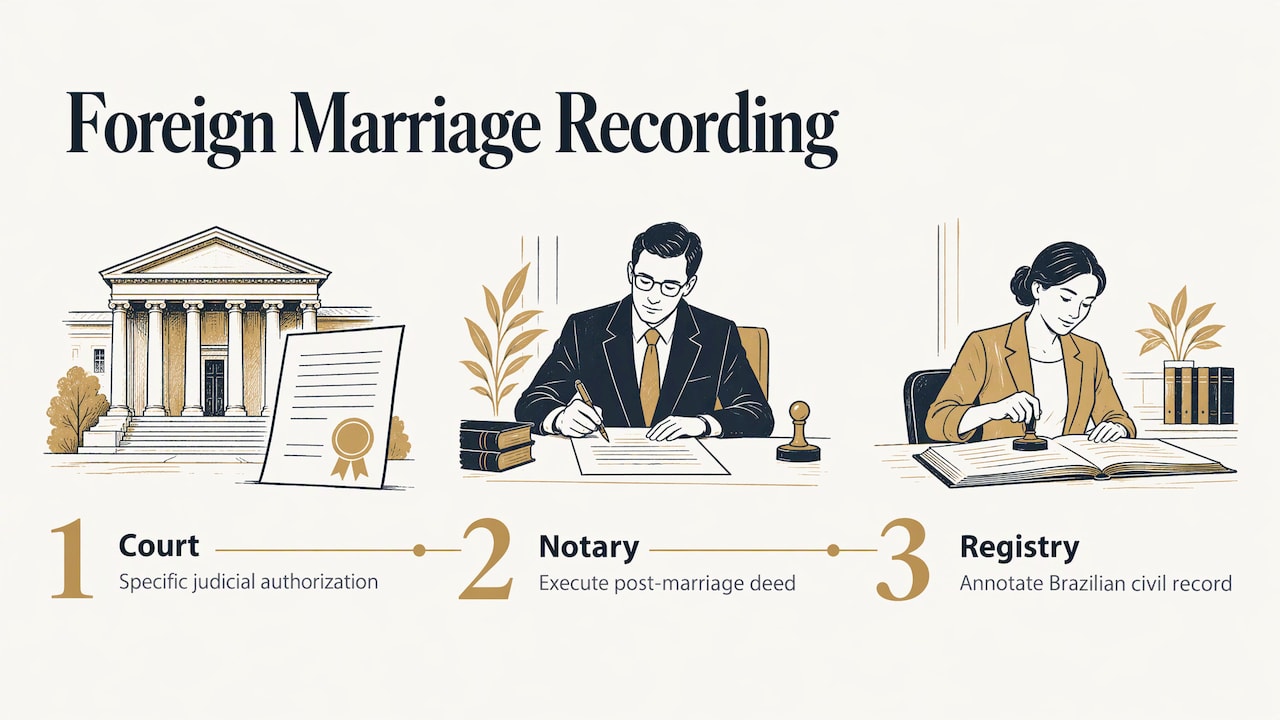
The Minas Gerais section of the Brazilian notarial association reported in January 2022 on a case where a post-marriage deed was executed after specific judicial authorization, for the Brazilian record of a marriage celebrated in England, and then presented for civil-registry annotation. The lesson is the sequence: a court, a notary and a registry each have a role. Cross-border files need someone who coordinates them.
If your marriage is going to be recorded in Brazil, decide the regime question before or as part of that process, not after a problem appears. If the marriage is ending instead, see our guides on divorcing in Brazil with a foreign spouse and recording a foreign divorce in Brazil.
When an agreement becomes a dispute
Disputes over marital property agreements tend to start from the same few pressure points. We describe them in general terms, because the outcome depends on the facts and on the court.
- Form problems. If the pre-wedding pact was not a public deed, the STJ’s account is that it is null and the default regime applies. A spouse who expected separation of assets may find the opposite.
- Clauses that go too far. Terms that cut against dignity or fundamental rights fall outside what the STJ says these pacts can contain.
- Third-party rights. A change of regime cannot be used to harm creditors. The Civil Code requires that their rights be preserved, which is why courts look at debts and publicity.
- Unclear records. A marriage celebrated abroad but recorded in Brazil with the wrong or missing regime creates conflicts between what the spouses believe and what the registry shows.
- Death or divorce. The regime decides how property is divided, and in an estate it interacts with the surviving spouse’s rights. See how the surviving spouse inherits in Brazil.
If you are on either side of a dispute, gather the marriage certificate, any pact or deed, property registry extracts and the court file if one exists, and bring them to a Brazilian family lawyer early. Deadlines and remedies depend on the specific document and court.
Is Brazil about to change these rules?
A bill to update the Civil Code, PL 4/2025, is moving through the National Congress. The official tracker shows it still under consideration in the Senate, with a rapporteur assigned as of a March 4, 2026 action. It is a bill, not law. The rules described above, including the Article 1,639 court route and the Article 1,640 default regime, are the ones that apply until Congress approves and the president enacts something different. A lawyer should confirm the current text before you file anything.
What a Brazilian postnuptial agreement lawyer should be able to do
When you hire counsel for a regime change, a pact review or a marital property dispute with Brazilian assets, look for these qualities:
- Brazilian family and property law as the core practice. The lawyer must be registered with the Brazilian bar (OAB) and comfortable before the family courts and registries.
- Cross-border fluency. You should be able to explain your US marriage, your assets and your goals in English and get answers in English.
- Direct access to the senior lawyer. Marital property planning involves personal facts. Handing them through intermediaries slows things down.
- Clear scope and fees up front. You should know what is included before you commit.
- Remote execution. Powers of attorney, signatures and hearings can be arranged without you flying in.
Our guide to Brazilian law for foreigners explains how these pieces fit together.
Our perspective
Most people who write to us have already signed something, often in the US, and assume it protects the apartment in Rio or the land in Cabo Frio. Usually it does not, at least not in the way they expect, because Brazilian property is governed by Brazilian rules on regimes, deeds and registries.
The good news is that the process is manageable once you see it as a sequence: understand the regime you are actually under, decide what you want, prepare the file honestly, and take it to the court and the registry in the right order. We have practiced Brazilian law since 2001, and we do this work with clients abroad every week through online consultations, in English or Portuguese, dealing directly with you, not through an intermediary.
Our advice is simple. Settle the regime question early, while both spouses agree, and before a company, an inheritance or a purchase makes it urgent.
Luís
Talk to a Brazilian lawyer about your marriage and your assets
Our firm, Marques Lima Advogados, has offices in Cabo Frio, Rio de Janeiro and Ithaca, New York, and we practice Brazilian law only. We help foreigners, dual citizens and Brazilians abroad with family law, property and inheritance matters in Brazil, with all consultations online in English or Portuguese and fees defined up front. The initial consultation is paid, and it is deductible from later legal fees if you proceed. You can start on our page for Brazilians abroad and the initial consultation, or read about our family law work in Brazil.
FAQ
Do I need a postnuptial agreement lawyer in the US or in Brazil?
It depends on where the assets and the marriage records are. For property in Brazil, the regime and the court process are Brazilian, so you need a Brazilian lawyer. For US assets and US courts, you need a US attorney, because we do not advise on US law.
Can a US postnup change my regime in Brazil?
Not by itself. Brazilian law treats a change of regime during the marriage as a matter for a joint, reasoned request and judicial authorization under Civil Code Article 1,639. A private US document may be evidence of your intentions, but a Brazilian lawyer must assess its effect before you rely on it.
What happens if my pre-wedding pact is invalid?
The STJ’s 2024 account says that if a required pact is not valid, the chosen regime is null and partial community applies. That is why the public deed form matters, and why a lawyer should review any pact before a purchase or a dispute.
Can we keep the agreement private from creditors?
No. The Civil Code requires the court to preserve third parties’ rights, and the 2014 STJ decision stresses publicity and a look at debts. A regime change cannot be used to avoid existing creditors.
Can we do all of this from abroad?
Usually yes. Our consultations are online, and signing and filing steps can be arranged remotely. Your lawyer will confirm which steps need a power of attorney in your case.
Sources
- Brazilian Civil Code (Law 10.406/2002), compiled text
- STJ: the court’s case law on the antenuptial pact (November 2024)
- STJ decision on changing the marital property regime, reproduced by a notarial publication
- CNB/MG article on the postnuptial pact and a marriage celebrated in England (2022)
- National Congress: PL 4/2025 tracker
Recommended
- Prenups and Property Regimes for Mixed Marriages
- Binational Couples in Brazil: Which Country’s Law Applies
- Prenuptial agreement in Brazil, and changing the regime
- Changing Your Marital Property Regime in Brazil
Want to get this done in Brazil?
Answer below and I will then help you pick a time for us to talk through your case.