
If an insurer or health plan in Brazil has denied your claim, the denial is rarely the end. It is the start of a process with fixed stages: get the reason in writing, take it to the insurer’s ombudsman, escalate to the regulator, and, if what you want is payment, file a lawsuit. The mistake most people living abroad make is stopping at the regulator and assuming that stops the clock on a lawsuit. It does not. This guide explains each stage under Brazilian law, so you know what to do, in what order, and where a Brazilian lawyer changes the outcome. We practice Brazilian law only, and we work with clients online, in English or Portuguese, without requiring them to travel.
TL;DR
- Ask for the denial in writing and read the stated reason. Brazilian health plans must give a grounded reason in clear language and cite the contract clause or legal provision behind it.
- Complain first to the insurer, then to its ombudsman (ouvidoria). Only after that do you go to the regulator: SUSEP for insurance, ANS for health plans.
- A SUSEP complaint can lead to sanctions against the company, but it does not pay your claim. For payment, you need a court action.
- A SUSEP proceeding does not suspend or interrupt the limitation period for a lawsuit, so do not wait on the regulator while time runs.
- Keep every protocol number, letter and email. They are your evidence at every stage.
Table of Contents
- Who regulates what in Brazil
- Why insurers deny claims
- Step by step: what to do after a denial
- The biggest mistake: waiting
- Which deadlines apply to health plans
- What a strong appeal file contains
- When a lawyer is worth involving
- Our perspective
- Getting help with a denial in Brazil
- FAQ
- Sources
Who regulates what in Brazil
Brazil splits insurance oversight between two bodies, and knowing which one applies saves weeks.
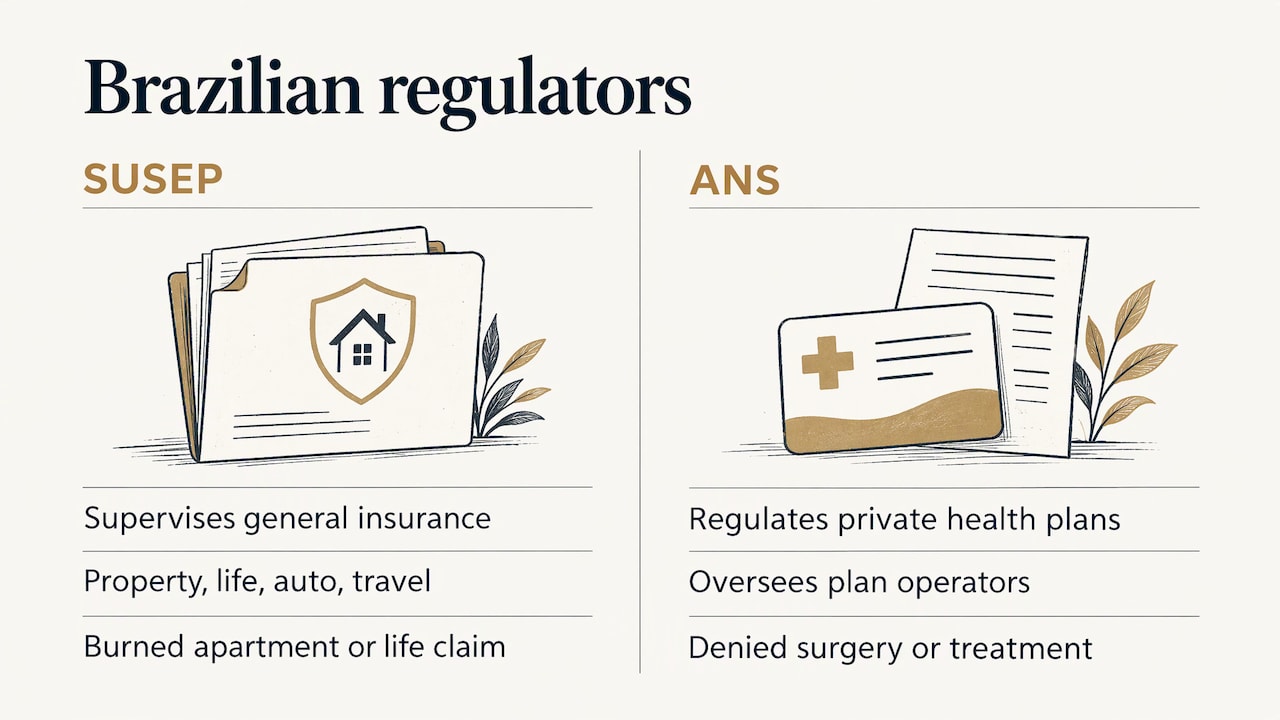
SUSEP (Superintendência de Seguros Privados) supervises insurance in general: property, life, auto, travel, and similar policies. ANS (Agência Nacional de Saúde Suplementar) regulates private health plans and the operators that run them. A denied surgery or treatment goes through ANS rules. A denied claim for a burned apartment or a life policy goes through SUSEP.
For readers abroad, the typical cases are: a property you own in Brazil damaged and the property insurer refuses to pay; a life or accident policy of a deceased relative whose beneficiaries live outside Brazil; or a Brazilian health plan you kept after moving. In each case the policy is governed by Brazilian law, whatever country you live in now.
Why insurers deny claims
A denial is the insurer’s refusal to pay the benefit you asked for. SUSEP’s FAQ lists situations where the insured can lose the right to indemnity: a loss caused by gross fault or intent, a fraudulent or bad-faith claim, false statements or attempts to obtain illicit benefits, and intentionally increased risk.
The same FAQ adds a point that surprises many policyholders: inaccurate statements or omissions that could have affected the insurer’s acceptance of the proposal or the premium can prejudice the indemnity, while you remain liable for the premium due. In practice, this is where many disputes sit. A property described as occupied when it was empty, a renovation not disclosed, or a health question answered loosely years ago can resurface when you file a claim.
Other common grounds are missing paperwork and a disagreement about whether the event is covered at all. The reason in the letter tells you which fight you are in, which is why step one below matters so much.
Step by step: what to do after a denial
1. Get the denial in writing and read the reason
Do not accept a phone call or a chat message as the answer. For health plans, the rules are explicit: under ANS Normative Resolution 623/2024, the operator must give the detailed reason for denying authorization, in clear and appropriate language, and identify the contract clause or legal provision that supports the denial. ANS’s consumer booklet adds that the written explanation must be in a format you can download or print.
Where it goes wrong: people read only the headline (“not covered”) and skip the clause cited. Compare that clause with your policy’s general conditions. If the clause does not say what the insurer claims, you have your first argument.
2. Check that your file was complete and on time
SUSEP advises the insured or beneficiary to notify the insurer immediately, complete the loss-notice form and submit the documents the policy’s general conditions require. The same FAQ says settlement should take no more than 30 days from delivery of all basic documents, but a justified doubt and a request for additional documents can suspend that clock until the request is fully met.
So a “denial” is sometimes really a request for more paperwork. Answer every request fully and in writing, and keep proof of delivery. Documents issued in Brazil are usually in Portuguese; if you are abroad, much of this can be handled through a power of attorney rather than a trip.
3. File a formal complaint with the insurer and its ombudsman
SUSEP’s educational guidance says consumers should first try to solve the problem directly with the insurer and only then contact SUSEP. Every contact generates a protocol number. Write each one down with the date.
For health plans, ANS guarantees the beneficiary the option to request reanalysis by the operator’s ombudsman, and the ordinary response period is no more than seven business days from the request. The operator defines and informs you of the procedure and timing for requesting reanalysis, and, according to ANS’s September 2025 FAQ, such a request does not suspend or interrupt the separate service-guarantee deadlines.
In a reanalysis request, answer the stated reason point by point. Attach the policy, the loss notice, photos, invoices, medical reports or death certificates, whatever proves the event and the cover. A generic “please reconsider” gets a generic reply.
4. Escalate to the regulator
If the insurer does not resolve it, you can complain to SUSEP (for insurance) or ANS (for health plans). ANS’s booklet advises keeping every service protocol and giving the operator’s protocol number when you contact ANS.
According to SUSEP’s consumer guide, complaints are forwarded to the company’s ombudsman for clarification or resolution. If there is no satisfactory answer within 15 days of referral, the complainant may request an administrative proceeding and submit supporting documents.
This step is useful and inexpensive, and a regulator’s inquiry sometimes prompts a company to revisit its position. But understand what it is, as the next section explains.
5. Decide whether the real remedy is a lawsuit
SUSEP explains that an administrative complaint investigates possible irregularities by the company and can lead to administrative sanctions. A consumer who wants the insurer to pay, or to perform another obligation, must go to court.
The same guide carries the warning that matters most for people abroad: a court action does not suspend the SUSEP administrative process, and a SUSEP proceeding does not suspend or interrupt the limitation period for the corresponding lawsuit. Limitation periods differ by type of claim and policy, so have a Brazilian lawyer confirm the period for yours as soon as the denial arrives, not after the regulator answers.
The biggest mistake: waiting
Three habits cost claimants the most.
- Treating the regulator as the court. A SUSEP or ANS complaint can sanction a company. It does not order payment to you, and it does not stop the limitation clock.
- Missing the paperwork loop. An unanswered request for documents can keep the settlement clock suspended and leave you with no decision to appeal.
- Losing the paper trail. Protocols, letters, emails and the original policy are the evidence. If you live abroad, store digital copies the day you receive anything.
A fourth applies to people living outside Brazil: serving papers and handling hearings from afar. Brazilian proceedings can be run through a lawyer with a power of attorney, which is why distance should not decide whether you pursue a valid claim.
Which deadlines apply to health plans
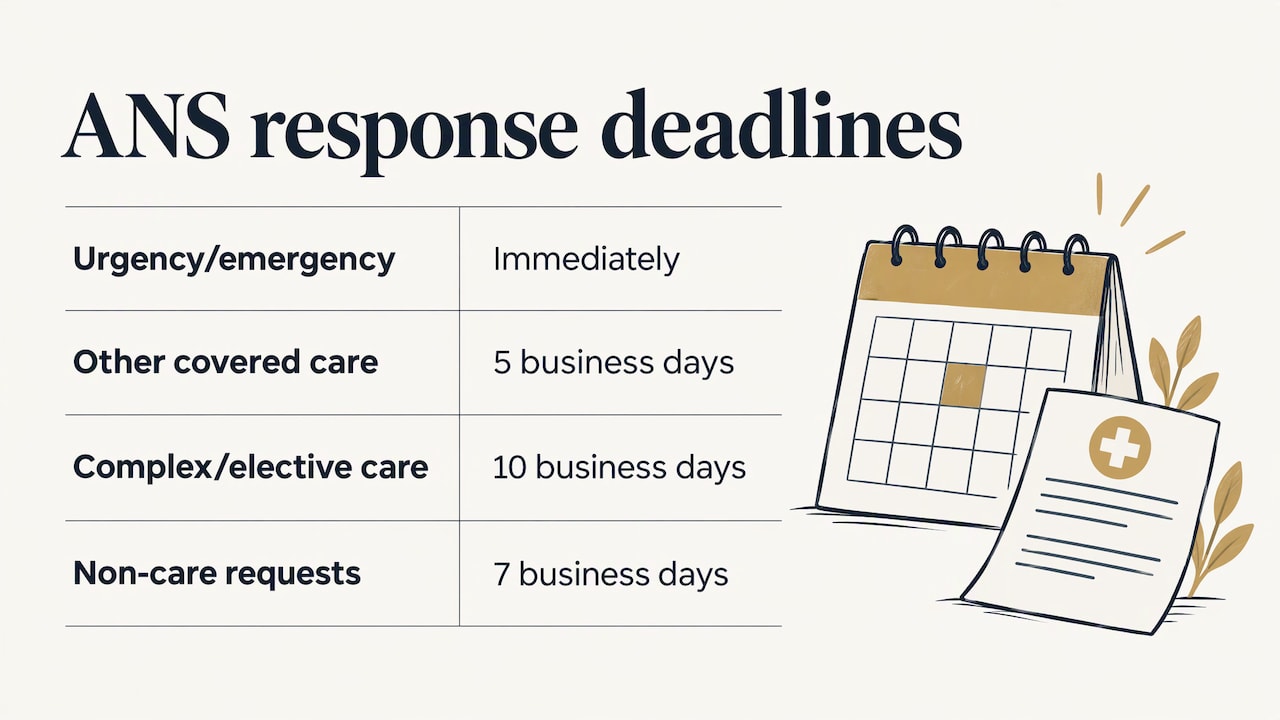
For health plan requests, ANS RN 623/2024 sets response deadlines. The operator must answer immediately in urgency or emergency cases, within five business days for other covered-care requests, within ten business days for high-complexity procedures or elective inpatient care, and within seven business days for non-care requests, according to the resolution. If a deadline passes without an answer, document it and bring it up in your ombudsman and ANS complaint.
If the denied treatment is urgent, the medical situation cannot wait for an administrative process. Speak to the treating doctor about the clinical risk, and to a Brazilian lawyer about whether to seek urgent court relief.
What a strong appeal file contains
| Item | Why it matters |
|---|---|
| The policy and general conditions | Shows what is covered and which clause the insurer relies on |
| The written denial | States the reason you must answer |
| Loss notice and proof of delivery | Starts the settlement clock |
| Evidence of the event (photos, reports, invoices, certificates) | Proves the loss and its amount |
| All protocol numbers and correspondence | Show you complained and when |
| Original application or health declaration | Lets you check any claim of false or omitted statements |
If the insurer’s reason is inaccurate declarations, the application form is the first document to examine. It shows exactly what you were asked and what you answered.
When a lawyer is worth involving
You can write the ombudsman complaint yourself. A lawyer matters when the insurer alleges misstatement or fraud, when the amount is significant (a property, a life policy for heirs), when you have limited time before a limitation period ends, or when you need to sue from abroad. Brazilian lawyers can structure the claim, deal with court formalities in Portuguese, and act on your behalf under a power of attorney. If you are comparing arrangements, our page on fees tied to the outcome in Brazil explains how outcome-based fees work in the country, and our page on an English-speaking lawyer in Brazil explains how remote representation works.
Our perspective
Most foreign clients come to us after months of back-and-forth with an insurer, usually after the regulator has acknowledged the complaint and the client assumes the matter is moving. It is a natural assumption, and it is the one that can cost a claim.
Our view is simple: treat the denial as a legal question from day one. Read the clause the insurer relies on, decide what outcome you want, and choose the route that can deliver it. If you want the company investigated, the regulator is the route. If you want the money, it is a court action under Brazilian law, and the deadline to file does not wait for the regulator.
That is why we work directly with the client, in English or Portuguese, online, with the scope and fees defined before the engagement. You speak with the senior attorney, not an intermediary. After 25 years of Brazilian practice, including cross-border cases for foreigners and Brazilians abroad dealing with property and inheritance in Brazil, we know how much easier a case is when the file is organized early.
We practice Brazilian law only. We do not advise on US law or appear in US courts, and we say so at the first conversation.
Luís
Getting help with a denial in Brazil
Our firm handles civil and consumer matters under Brazilian law for foreigners, dual citizens and Brazilians living abroad. The first step is an online initial consultation, which is paid and deductible from later legal fees if you proceed. We review the denial letter, the policy and your timeline, then quote a fixed fee before any engagement. You can book through our page for Brazilians abroad and the initial consultation.
If the policy belonged to a relative who died in Brazil, the claim often sits alongside an estate. Our inheritance support for heirs abroad covers that side of the process.
FAQ
Can I appeal a denied insurance claim from outside Brazil?
Yes. The complaint to the insurer, its ombudsman and the regulator can all be made remotely, and a lawsuit can be run by a Brazilian lawyer acting under a power of attorney. You do not need to travel for the process itself. Keep digital copies of every document and protocol.
Does a complaint to SUSEP stop the deadline for suing?
No. SUSEP’s own guide states that its administrative proceeding does not suspend or interrupt the limitation period for the related court action. Have a Brazilian lawyer confirm the period for your type of policy as soon as you receive the denial.
How long does the insurer have to answer?
For insurance generally, SUSEP says settlement should take no more than 30 days after delivery of all basic documents, though a justified request for extra documents can suspend the count. For health plans, ANS RN 623/2024 sets deadlines from immediate (urgency) to ten business days depending on the type of request.
What documents should I send with an appeal?
Send the policy and general conditions, the written denial, the loss notice, proof of the event and its value, and every protocol number. Answer the insurer’s stated reason directly, clause by clause. For a health plan, include the doctor’s report supporting the treatment.
Should I go to the regulator or to court?
It depends on your goal. SUSEP or ANS can investigate the company and apply sanctions, but payment of your claim requires a court action. Many people do both, as long as the lawsuit is not delayed by waiting on the regulator.
Sources
- SUSEP, Perguntas mais frequentes sobre seguros
- SUSEP, Pílula 17: O que fazer em caso de problemas
- SUSEP, Guia de orientação ao consumidor
- ANS, Relacionamento com o Consumidor (2025)
- ANS Normative Resolution 623/2024, Ministério da Saúde
- ANS, FAQ RN 623 (September 2025)
Recommended
Want to get this done in Brazil?
Answer below and I will then help you pick a time for us to talk through your case.