
In short: after an arrest in the act (in flagrante), the family must be notified immediately (Constitution, art. 5, LXII). Within 24 hours the arrest report goes to the judge and the detainee receives the written statement of the grounds for the arrest (Code of Criminal Procedure, art. 306). Within the same 24 hours the custody hearing must take place, at which the judge decides whether the arrest is set aside, converted into pre-trial detention or replaced by provisional release (Code of Criminal Procedure, art. 310). This is the window in which the defence makes the most difference.
An arrest in the act throws everything into disorder within minutes. The person arrested loses their phone, the family finds out from third parties, and nobody knows which police station they are at or what will happen next. And the clock is already running.
Brazilian law divides the first hours into well-defined stages, with short deadlines. Knowing each of them helps the family act in the right order, and helps the lawyer reach the custody hearing with what really weighs in the judge’s decision. Below is the full path, from the moment of arrest to the decision on release.
What an arrest in the act is
An arrest in the act is one made without a judge’s order, because the person was caught at the moment of the offence or shortly after it. The Code of Criminal Procedure defines four situations (art. 302):
- the person is committing the offence;
- the person has just committed it;
- the person is pursued, right afterwards, in circumstances that suggest they are the perpetrator;
- the person is found, shortly afterwards, with instruments, weapons, objects or papers that suggest they are the perpetrator.
Outside those situations, only a judge can order an arrest, by a written and reasoned order (Constitution, art. 5, LXI). That is why the defence’s first question is always the same: was it really an arrest in the act? If it was not, the arrest is unlawful and must be set aside immediately (art. 5, LXV).
The first 24 hours, step by step
| When | What happens | Legal basis |
|---|---|---|
| At the moment of arrest | The person is informed of their rights, including the right to silence | Constitution, art. 5, LXIII |
| Immediately | Notice to the judge, the Public Prosecutor’s Office and the family | Constitution, art. 5, LXII; CPP, art. 306 |
| At the police station | Arrest report; bail if the maximum penalty is up to 4 years | CPP, arts. 304 and 322 |
| Within 24 hours | Report sent to the judge; copy to the Public Defender’s Office if there is no lawyer; statement of grounds for the arrest | CPP, art. 306, §§ 1 and 2 |
| Within 24 hours | Custody hearing: arrest set aside, pre-trial detention or provisional release | CPP, art. 310 |
1. At the police station: the arrest report
The detainee is brought before the police authority, which hears the officer who made the arrest, the witnesses and, last of all, the detainee, and then draws up the arrest report, known in Brazil as the “auto de prisão em flagrante” (Code of Criminal Procedure, art. 304). The detainee must be informed of their rights, among them the right to remain silent, with the assistance of family and of a lawyer (Constitution, art. 5, LXIII). They also have the right to know who is responsible for the arrest and for the questioning (art. 5, LXIV).
What the detainee says at this moment, under pressure and without a lawyer, is what most often weighs against them later. The right to silence exists precisely for this hour.
2. Immediate notice to the family and the judge
The arrest and the place where the person is being held must be reported immediately to the judge, to the Public Prosecutor’s Office and to the detainee’s family or to whoever the detainee names (Constitution, art. 5, LXII; Code of Criminal Procedure, art. 306). If the family was not told, that in itself is a point to raise with the judge.
3. Within 24 hours: report to the judge and statement of grounds
Within 24 hours the arrest report is sent to the judge. If the detainee does not give the name of a lawyer, a full copy goes to the Public Defender’s Office. Within the same period, the detainee receives the “nota de culpa”, a written statement with the reason for the arrest, the name of the person who made it and the names of the witnesses (Code of Criminal Procedure, art. 306, §§ 1 and 2).
4. Bail at the police station itself, when available
The police chief can grant bail when the maximum penalty for the crime does not exceed 4 years. Above that, bail is requested from the judge, who decides within 48 hours (Code of Criminal Procedure, art. 322). For minor offences, those with a maximum penalty of up to 2 years, the rule is different: a summary incident report is drawn up and, if the person undertakes to appear before the Special Criminal Court, no arrest in the act is imposed and no bail is required (Law No. 9,099/1995, arts. 61 and 69).
The custody hearing
Once the arrest report has been received, the judge must hold the custody hearing within a maximum of 24 hours after the arrest, with the detainee, the retained lawyer or the Public Defender’s Office, and the Public Prosecutor’s Office present. Since Law No. 15,358 of March 2026, the Code of Criminal Procedure provides for this hearing to take place by real-time videoconference (art. 310).
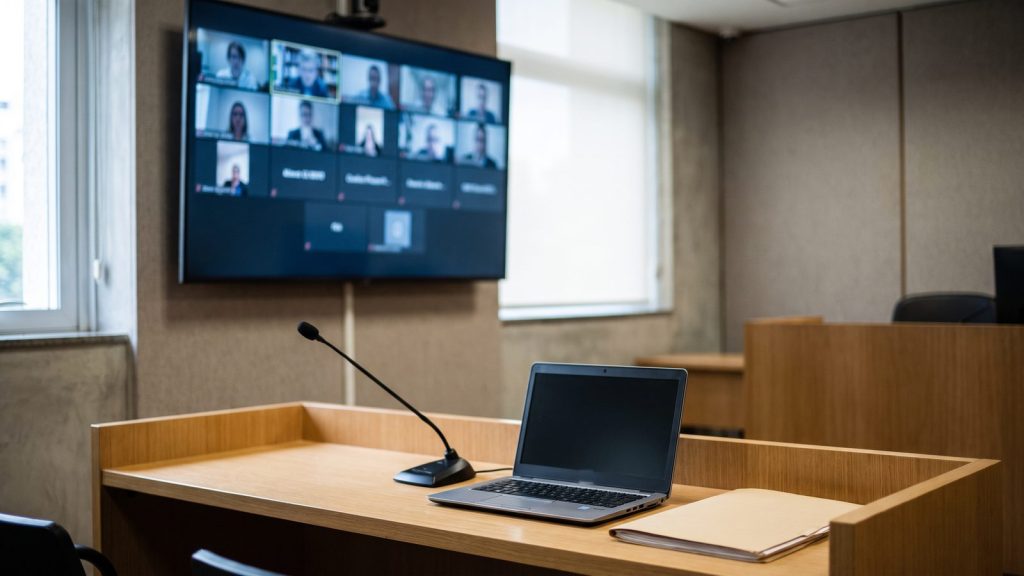
At this hearing the judge has three options, and must give reasons for the one chosen (Code of Criminal Procedure, art. 310):
- Set the arrest aside, if it was unlawful.
- Convert the arrest into pre-trial detention, if the requirements of art. 312 are met and precautionary measures other than detention are inadequate or insufficient.
- Grant provisional release, with or without bail, possibly with precautionary measures such as periodic reporting to the court or a ban on leaving the country.
The Constitution is clear: no one shall be taken to prison or kept there when the law allows provisional release (art. 5, LXVI). And the Code of Criminal Procedure reinforces it: if the requirements for pre-trial detention are absent, the judge must grant provisional release (art. 321).
What weighs in the judge’s decision
The custody hearing is not the trial of the crime. The judge does not decide whether the person is guilty, but whether they need to remain in custody while the case is investigated. That is why what weighs most are facts about the person, and the family can gather a good part of them within a few hours:
- proof of a fixed address;
- proof of work or study (employment record, contract, letter from the employer);
- documents of children or dependants who live with the detainee;
- certificates showing there are no other cases, where applicable;
- medical reports or prescriptions, if there is a relevant health condition.
Arriving at the hearing with these documents in order is very different from arriving with a verbal explanation. The deadline is short, and that is why the family has to act while the detainee is still at the police station. If the family lives abroad, legible photos sent to the lawyer serve the same purpose.
What the family should do now
- Find out where the person is and write down the case number. If no one has told you, see the step-by-step guide in family member arrested in Brazil: how to find out where they are.
- Bring in a lawyer immediately. If the detainee does not name a lawyer, the case goes to the Public Defender’s Office, which assists those who cannot pay.
- Gather the documents on the list above, as legible photos, and send them to the lawyer.
- Do not discuss the facts by phone or message with the detainee or with other people involved.
- If the detainee is a foreign national, they may ask for their country’s consulate to be informed. In that case, the authorities must notify the consular post without delay (Vienna Convention on Consular Relations, Decree No. 61,078/1967, art. 36).
After the custody hearing
If the person leaves on provisional release, the conditions imposed must be followed to the letter: breaching a precautionary measure is the shortest route to pre-trial detention. If retention of the passport is among them, see passport retained in Brazil: what it means and how to respond.
If the arrest is converted into pre-trial detention, the defence goes on. The judge may revoke it when there is no longer a reason to maintain it, and must review whether it is still necessary every 90 days, in a reasoned decision (Code of Criminal Procedure, art. 316). There are also ways to challenge it in the higher courts. In either case the police inquiry continues, and the next relevant stage is usually the indictment and the summons, with a 10-day deadline for the written response to the charges.
Frequently asked questions
Can the family attend the custody hearing?
The mandatory participants are the detainee, the lawyer or public defender and the Public Prosecutor’s Office. The family helps in another way: by getting to the lawyer, before the hearing, the documents that show residence, work and ties.
How much is bail?
The law sets ranges: from 1 to 100 Brazilian minimum monthly wages when the maximum penalty for the crime does not exceed 4 years, and from 10 to 200 minimum wages above that (Code of Criminal Procedure, art. 325). Within the range, the nature of the offence, the financial circumstances and the past record of the person arrested are taken into account (art. 326). If the person cannot pay, the judge may grant provisional release without bail, with other obligations (art. 350). Before paying, confirm with the lawyer that bail really is the best route.
Does the detainee have to talk at the police station?
No. They must be informed of the right to remain silent (Constitution, art. 5, LXIII), and silence cannot be interpreted against the defence (Code of Criminal Procedure, art. 186). Before speaking with a lawyer, staying silent about the facts is almost always the safest decision.
What if it was not an arrest in the act?
Then it requires a written and reasoned order from a judge. Arrest warrants are recorded in a database kept by Brazil’s National Council of Justice (Code of Criminal Procedure, art. 289-A), and a lawyer can check the order and the case it came from.
What to do with this information
If the arrest has just happened, the deadline that matters is the 24 hours until the custody hearing. Within that window: locate the person, bring in the lawyer and gather the documents on residence, work and family. Write “urgent” in the form on our criminal law page: arrest cases are read first, and the firm works together with a criminal defence lawyer admitted before the court where the case is being heard.
Sources: Federal Constitution of Brazil, art. 5, LXI to LXVI; Code of Criminal Procedure (Decree-Law No. 3,689/1941), arts. 186, 289-A, 302, 304, 306, 310 (as worded by Law No. 15,358/2026), 312, 316, 321, 322, 325, 326 and 350; Law No. 9,099/1995 (Special Civil and Criminal Courts), arts. 61 and 69; Decree No. 61,078/1967 (Vienna Convention on Consular Relations), art. 36. Texts checked against the version published by Brazil’s Chamber of Deputies on 14 November 2026. Informational content; not legal advice.

is a lawyer admitted in Brazil (OAB/RJ 113.775). This article is informational and does not constitute legal advice on any specific matter. Brazilian law matters are handled from abroad under power of attorney; matters of United States law are conducted with a US-licensed attorney.
Facing a criminal matter in Brazil?
Answer below and I will then help you pick a time for us to talk through your case.